
9.1 KiB
Test Reporter
This Github Action displays test results from popular testing frameworks directly in GitHub.
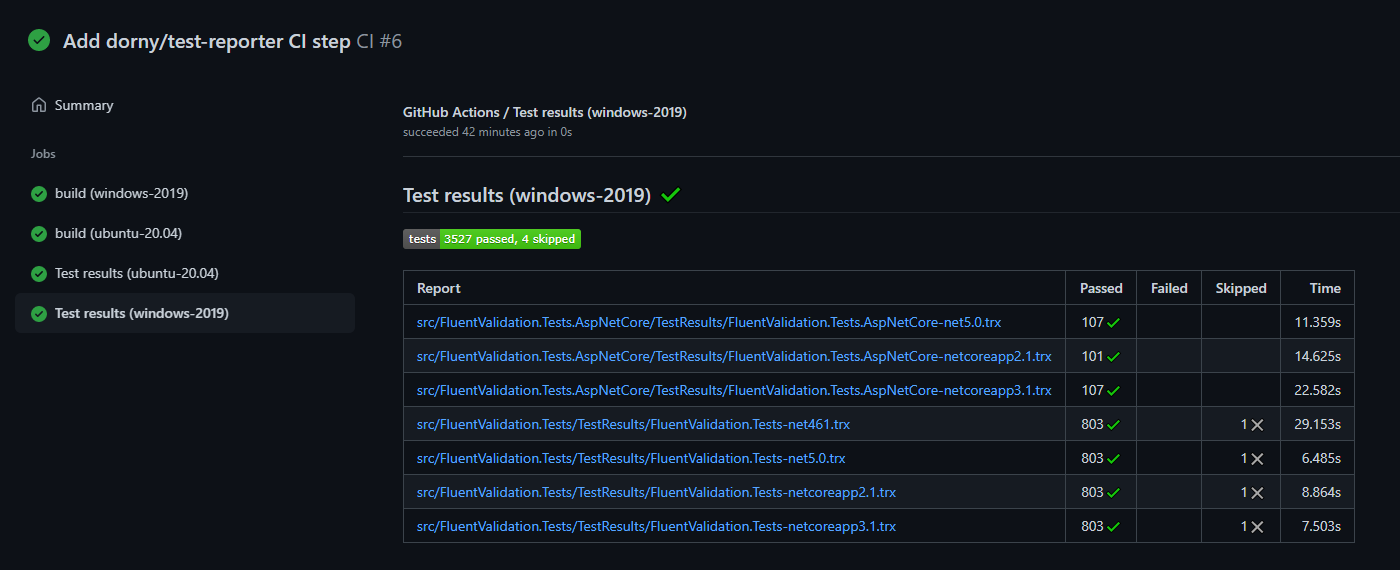
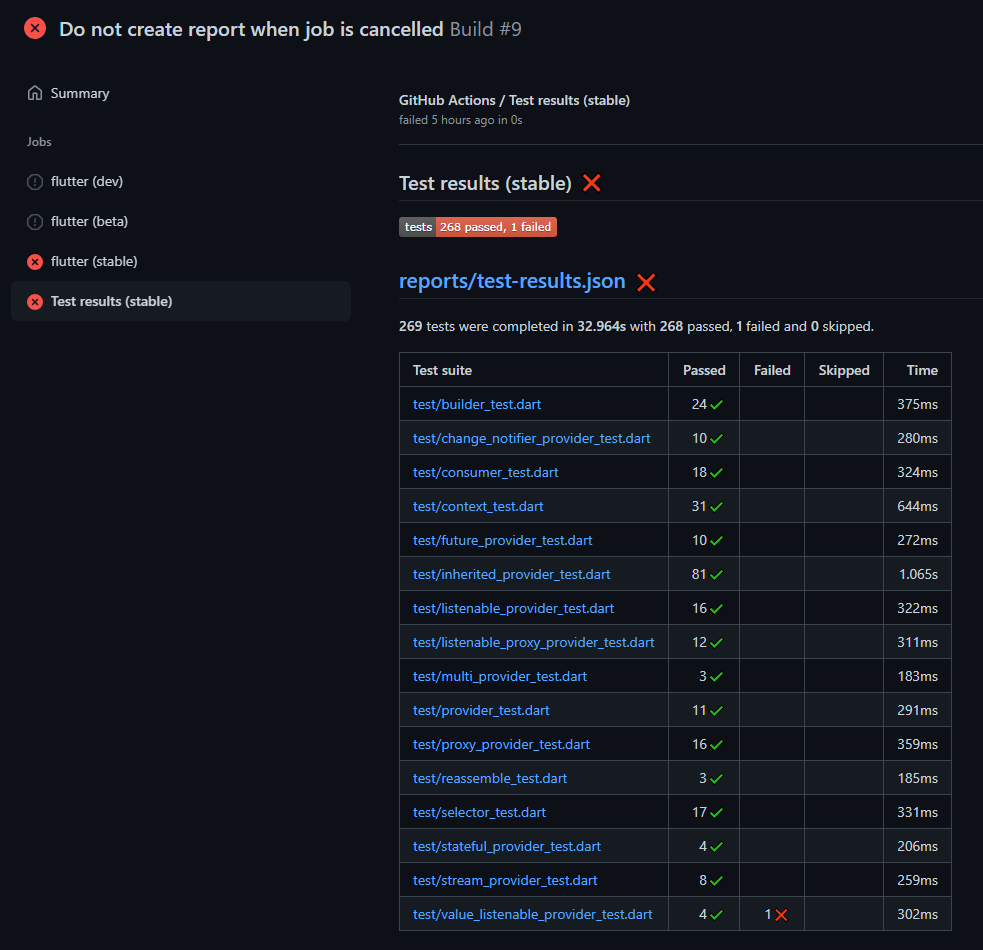
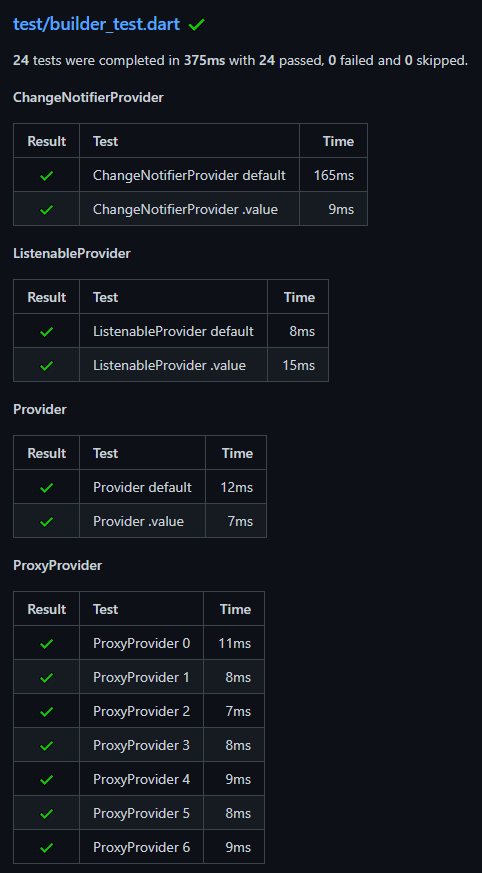
✔️ Parses test results in XML or JSON format and creates nice report as Github Check Run
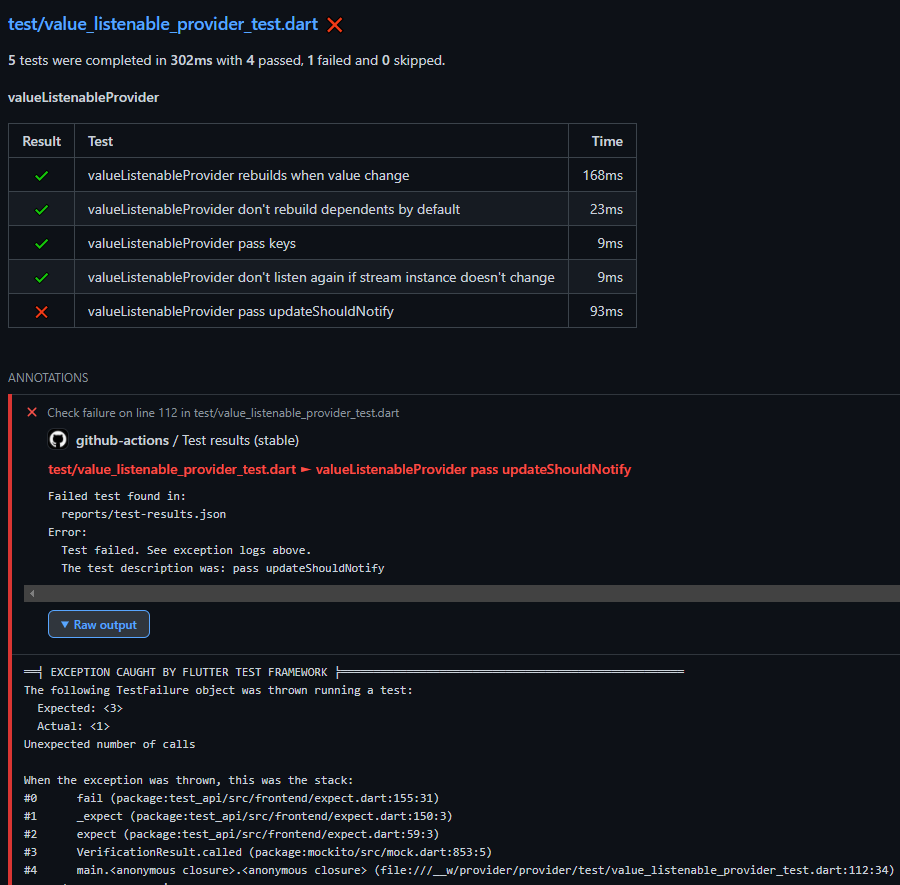
✔️ Annotates code where it failed based on message and stack trace captured during test execution
✔️ Provides final conclusion and counts of passed, failed and skipped tests as output parameters
How it looks:
 |
 |
 |
 |
|---|
Supported languages / frameworks:
For more information see Supported formats section.
Do you miss support for your favorite language or framework? Please create Issue or contribute with PR.
Example
Following setup does not work in workflows triggered by pull request from forked repository. If that's fine for you, using this action is as simple as:
on:
  pull_request:
  push:
jobs:
  build-test:
    name: Build & Test
    runs-on: ubuntu-latest
    steps:
      - uses: actions/checkout@v2     # checkout the repo
      - run: npm ci                   # install packages
      - run: npm test                 # run tests (configured to use jest-junit reporter)

      - name: Test Report
        uses: dorny/test-reporter@v1
        if: success() || failure()    # run this step even if previous step failed
        with:
          name: JEST Tests            # Name of the check run which will be created
          path: reports/jest-*.xml    # Path to test results
          reporter: jest-junit        # Format of test results
Recommended setup for public repositories
Workflows triggered by pull requests from forked repositories are executed with read-only token and therefore can't create check runs. To workaround this security restriction it's required to use two separate workflows:
CIruns in the context of PR head branch with read-only token. It executes the tests and uploads test results as build artifactTest Reportruns in the context of repository main branch with read/write token. It will download test results and create reports
PR head branch: .github/workflows/ci.yml
name: 'CI'
on:
  pull_request:
jobs:
  build-test:
    runs-on: ubuntu-latest
    steps:
      - uses: actions/checkout@v2         # checkout the repo
      - run: npm ci                       # install packages
      - run: npm test                     # run tests (configured to use jest-junit reporter)
      - uses: actions/upload-artifact@v2  # upload test results
        if: success() || failure()        # run this step even if previous step failed
        with:
          name: test-results
          path: jest-junit.xml
default branch: .github/workflows/test-report.yml
name: 'Test Report'
on:
  workflow_run:
    workflows: ['CI']                     # runs after CI workflow
    types:
      - completed
jobs:
  report:
    runs-on: ubuntu-latest
    steps:
    - uses: dorny/test-reporter@v1
      with:
        artifact: test-results            # artifact name
        name: JEST Tests                  # Name of the check run which will be created
        path: '*.xml'                     # Path to test results (inside artifact .zip)
        reporter: jest-junit              # Format of test results
Usage
- uses: dorny/test-reporter@v1
  with:

    # Name or regex of artifact containing test results
    # Regular expression must be enclosed in '/'.
    # Values from captured groups will replace occurrences of $N in report name.
    # Example:
    #   artifact: /test-results-(.*)/
    #   name: 'Test report $1'
    #   -> Artifact 'test-result-ubuntu' would create report 'Test report ubuntu'
    artifact: ''

    # Name of the Check Run which will be created
    name: ''

    # Coma separated list of paths to test results
    # Supports wildcards via [fast-glob](https://github.com/mrmlnc/fast-glob)
    # All matched result files must be of same format
    path: ''

    # Format of test results. Supported options:
    #   dart-json
    #   dotnet-trx
    #   flutter-json
    #   jest-junit
    reporter: ''

    # Limits which test suites are listed:
    #   all
    #   failed
    list-suites: 'all'

    # Limits which test cases are listed:
    #   all
    #   failed
    #   none
    list-tests: 'all'

    # Limits number of created annotations with error message and stack trace captured during test execution.
    # Must be less or equal to 50.
    max-annotations: '10'

    # Set action as failed if test report contain any failed test
    fail-on-error: 'true'

    # Relative path under $GITHUB_WORKSPACE where the repository was checked out.
    working-directory: ''

    # Personal access token used to interact with Github API
    # Default: ${{ github.token }}
    token: ''
Output parameters
| Name | Description |
|---|---|
| conclusion | success or failure |
| passed | Count of passed tests |
| failed | Count of failed tests |
| skipped | Count of skipped tests |
| time | Test execution time [ms] |
Supported formats
dart-json
Test run must be configured to use JSON reporter.
You can configure it in dart_test.yaml:
file_reporters:
  json: reports/test-results.json
Or with CLI arguments:
dart test --file-reporter="json:test-results.json"
For more information see:
dotnet-trx
Test execution must be configured to produce Visual Studio Test Results files (TRX). To get test results in TRX format you can execute your tests with CLI arguments:
dotnet test --logger "trx;LogFileName=test-results.trx"
Or you can configure TRX test output in *.csproj or Directory.Build.props:
<PropertyGroup>
  <VSTestLogger>trx%3bLogFileName=$(MSBuildProjectName).trx</VSTestLogger>
  <VSTestResultsDirectory>$(MSBuildThisFileDirectory)/TestResults/$(TargetFramework)</VSTestResultsDirectory>
</PropertyGroup>
Supported testing frameworks:
For more information see dotnet test
flutter-json
Test run must be configured to use JSON reporter.
You can configure it in dart_test.yaml:
file_reporters:
  json: reports/test-results.json
Or with (undocumented) CLI argument:
flutter test --machine > test-results.json
According to documentation dart_test.yaml should be at the root of the package, next to the package's pubspec.
On current stable and beta channels it doesn't work and you have to put dart_test.yaml inside your test folder.
On dev channel it's already fixed.
For more information see:
jest-junit
JEST testing framework support requires usage of jest-junit reporter.
It will create test results in junit XML format which can be then processed by this action.
You can use following example configuration in package.json:
"scripts": {
  "test": "jest --ci --reporters=default --reporters=jest-junit"
},
"devDependencies": {
  "jest": "^26.5.3",
  "jest-junit": "^12.0.0"
},
"jest-junit": {
  "outputDirectory": "reports",
  "outputName": "jest-junit.xml",
  "ancestorSeparator": " › ",
  "uniqueOutputName": "false",
  "suiteNameTemplate": "{filepath}",
  "classNameTemplate": "{classname}",
  "titleTemplate": "{title}"
}
Configuration of uniqueOutputName, suiteNameTemplate, classNameTemplate, titleTemplate is important for proper visualization of test results.
See also
- paths-filter - Conditionally run actions based on files modified by PR, feature branch or pushed commits
License
The scripts and documentation in this project are released under the MIT License