| .github | ||
| .vscode | ||
| __tests__ | ||
| assets | ||
| dist | ||
| reports | ||
| src | ||
| .editorconfig | ||
| .eslintignore | ||
| .eslintrc.json | ||
| .gitattributes | ||
| .gitignore | ||
| .prettierignore | ||
| .prettierrc.json | ||
| action.yml | ||
| jest.config.js | ||
| LICENSE | ||
| package-lock.json | ||
| package.json | ||
| README.md | ||
| tsconfig.json | ||

Test Reporter
This Github Action displays test results from popular testing frameworks directly in GitHub.
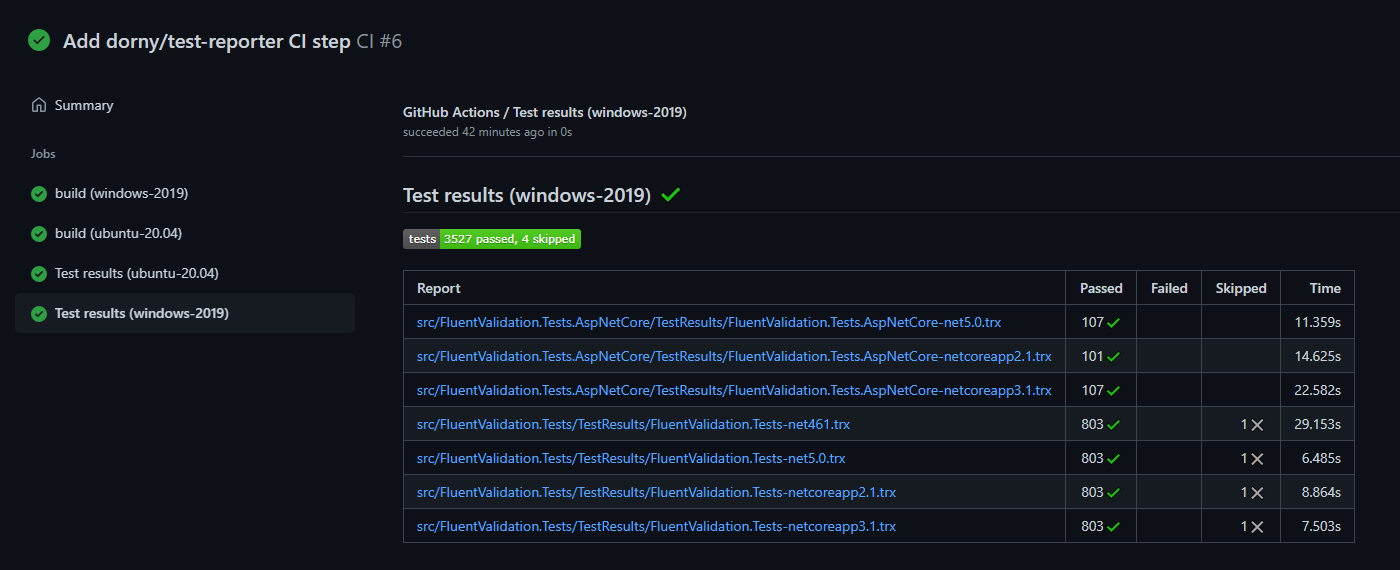
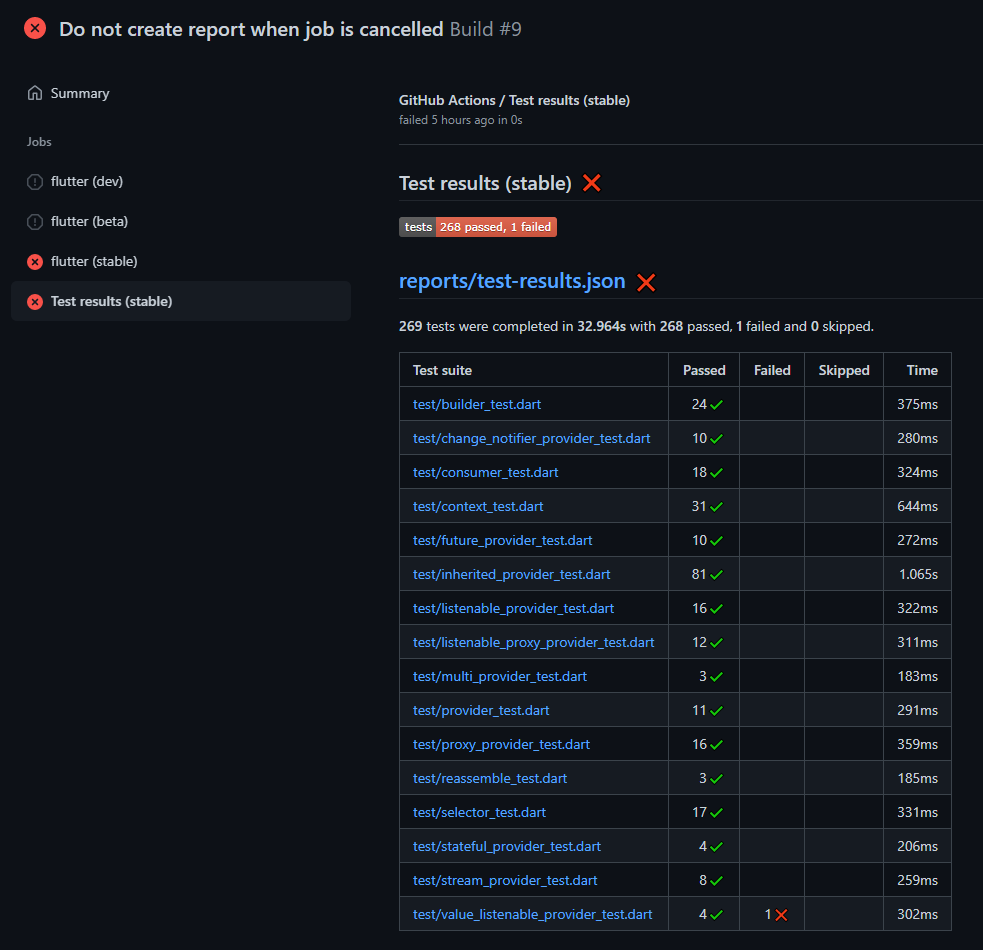
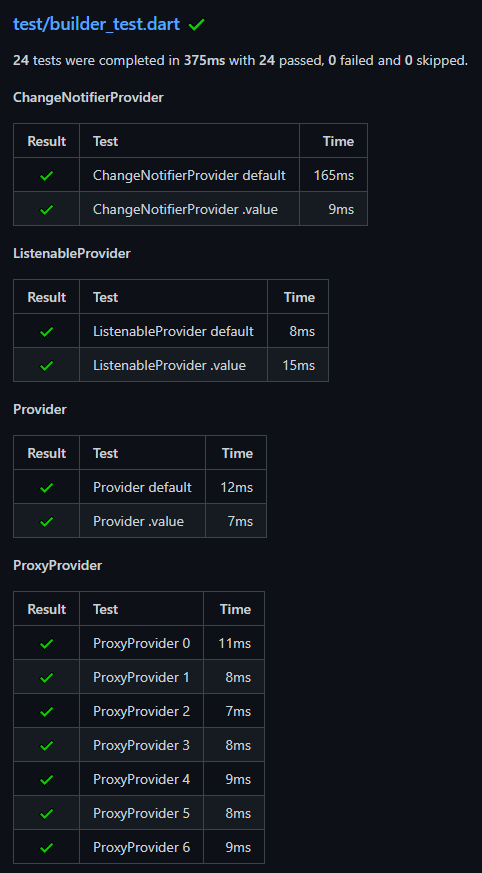
✔️ Parses test results in XML or JSON format and creates nice report as Github Check Run
✔️ Annotates code where it failed based on message and stack trace captured during test execution
✔️ Provides final conclusion and counts of passed, failed and skipped tests as output parameters
How it looks:
 |
 |
 |
 |
|---|
Supported languages / frameworks:
For more information see Supported formats section.
Support is planned for:
- Java / JUnit 5
Do you miss support for your favorite language or framework? Please create Issue or contribute with PR.
Example
jobs:
  build-test:
    name: Build & Test
    runs-on: ubuntu-latest
    steps:
      - uses: actions/checkout@v2     # checkout the repo
      - run: npm ci                   # install packages
      - run: npm test                 # run tests (configured to use jest-junit reporter)

      - name: Test Report
        uses: dorny/test-reporter@v1
        if: success() || failure()    # run this step even if previous step failed
        with:
          name: JEST Tests            # Name of the check run which will be created
          path: reports/jest-*.xml    # Path to test report
          reporter: jest-junit        # Format of test report
Usage
- uses: dorny/test-reporter@v1
  with:

    # Name of the Check Run which will be created
    name: ''

    # Coma separated list of paths to test reports
    # Supports wildcards via [fast-glob](https://github.com/mrmlnc/fast-glob)
    # All matched result files must be of same format
    path: ''

    # Format of test report. Supported options:
    #   dart-json
    #   dotnet-trx
    #   flutter-json
    #   jest-junit
    reporter: ''

    # Limits which test suites are listed:
    #   all
    #   failed
    list-suites: 'all'

    # Limits which test cases are listed:
    #   all
    #   failed
    #   none
    list-tests: 'all'

    # Limits number of created annotations with error message and stack trace captured during test execution.
    # Must be less or equal to 50.
    max-annotations: '10'

    # Set action as failed if test report contain any failed test
    fail-on-error: 'true'

    # Relative path under $GITHUB_WORKSPACE where the repository was checked out.
    working-directory: ''

    # Personal access token used to interact with Github API
    # Default: ${{ github.token }}
    token: ''
Output parameters
| Name | Description |
|---|---|
| conclusion | success or failure |
| passed | Count of passed tests |
| failed | Count of failed tests |
| skipped | Count of skipped tests |
| time | Test execution time [ms] |
Supported formats
dart-json
Test run must be configured to use JSON reporter.
You can configure it in dart_test.yaml:
file_reporters:
  json: reports/test-results.json
Or with CLI arguments:
dart test --file-reporter="json:test-results.json"
For more information see:
dotnet-trx
Test execution must be configured to produce Visual Studio Test Results files (TRX). To get test results in TRX format you can execute your tests with CLI arguments:
dotnet test --logger "trx;LogFileName=test-results.trx"
Or you can configure TRX test output in *.csproj or Directory.Build.props:
<PropertyGroup>
  <VSTestLogger>trx%3bLogFileName=$(MSBuildProjectName).trx</VSTestLogger>
  <VSTestResultsDirectory>$(MSBuildThisFileDirectory)/TestResults/$(TargetFramework)</VSTestResultsDirectory>
</PropertyGroup>
Supported testing frameworks:
For more information see dotnet test
flutter-json
Test run must be configured to use JSON reporter.
You can configure it in dart_test.yaml:
file_reporters:
  json: reports/test-results.json
Or with (undocumented) CLI argument:
flutter test --machine > test-results.json
According to documentation dart_test.yaml should be at the root of the package, next to the package's pubspec.
On current stable and beta channels it doesn't work and you have to put dart_test.yaml inside your test folder.
On dev channel it's already fixed.
For more information see:
jest-junit
JEST testing framework support requires usage of jest-junit reporter.
It will create test results in junit XML format which can be then processed by this action.
You can use following example configuration in package.json:
"scripts": {
  "test": "jest --ci --reporters=default --reporters=jest-junit"
},
"devDependencies": {
  "jest": "^26.5.3",
  "jest-junit": "^12.0.0"
},
"jest-junit": {
  "outputDirectory": "reports",
  "outputName": "jest-junit.xml",
  "ancestorSeparator": " › ",
  "uniqueOutputName": "false",
  "suiteNameTemplate": "{filepath}",
  "classNameTemplate": "{classname}",
  "titleTemplate": "{title}"
}
Configuration of uniqueOutputName, suiteNameTemplate, classNameTemplate, titleTemplate is important for proper visualization of test results.
See also
- paths-filter - Conditionally run actions based on files modified by PR, feature branch or pushed commits
License
The scripts and documentation in this project are released under the MIT License